04 · Sports Betting Rules (Group Standard)
Target Audience: All operations team members (Team Lead / Deputy Lead / Customer Service) Content Source: Group Sports Betting Rules.xlsx Author: Provided by Group | Compiled: 2026-04-29
This document covers all market rules, match categories, match progress, and sport-specific knowledge for football, basketball, tennis, and baseball.
Table of Contents
- 1. Market Fundamentals
- 1.1 1X2 Match Result (独赢)
- 1.2 Handicap (让球)
- 1.3 Over/Under (大/小)
- 1.4 Odd/Even (单/双)
- 1.5 Correct Score (波胆)
- 1.6 First/Last Goal
- 1.7 Total Goals
- 1.8 Half Time/Full Time (半/全场)
- 1.9 Double Chance (双重机会)
- 1.10 Clean Sheet (零失球)
- 1.11 Clean Sheet Win
- 1.12 Both Teams to Score
- 1.13 Winning Margin
- 1.14 Win Either Half
- 1.15 Win Both Halves
- 1.16 Handicap Home/Draw/Away
- 1.17 Handicap + 1X2
- 1.18 Combo Markets (1X2 & Over/Under, etc.)
- 1.19 Highest Scoring Half
- 1.20 Score in Both Halves
- 1.21 Win in Regular Time
- 1.22 Booking Points (罚牌数)
- 1.23 Time of First Goal
- 1.24 Home or Both Teams to Score / Away or Both Teams to Score / Draw or Both Teams to Score
- 1.25 Sending Off
- 1.26 Basketball · Highest Scoring Quarter
- 1.27 Basketball · First Free Throw Team
- 2. Match Categories
- 2.1 Live/In-Play (滚球)
- 2.2 Upcoming
- 2.3 Today
- 2.4 Early Markets
- 2.5 Accumulator/Parlay (串关)
- 3. Match Progress
- 3.1 Full Time
- 3.2 Half Time
- 3.3 Extra Time
- 3.4 Football Penalty Shootout
- 3.5 Football Sudden Death
- 4. Sports Knowledge
- 4.1 Home Ground / Home Team
- 4.2 Away Ground / Away Team
- 4.3 Neutral Venue
- 4.4 Odds
- 4.5 Youth Tournaments U16–U21
- 4.6 Abandoned Match
- 4.7 Danger Ball
- 4.8 Valid Turnover (有效投注)
- 4.9 Top Five Leagues
- 4.10 World Cup
- 4.11 Match Anomalies
- 4.12 Number of Players
- 4.13 Basketball
- 4.14 Football Corners
- 5. Tennis Knowledge
- 5.1 Game
- 5.2 Set
- 5.3 Market Knowledge
- 5.4 Scoring Method
- 5.5 Tiebreak (7-Point)
- 5.6 Match Tiebreak (10-Point)
- 5.7 Scoring
- 6. Baseball Knowledge
- 6.1 Baseball Fundamentals
- 6.2 Common 9th Inning Questions
- 6.3 International Rules (Mercy Rule / Early Termination)
- 6.4 International Rules (Run Line / Totals)
1. Market Fundamentals
1.1 1X2 Match Result (独赢)
Definition: Predict the match result — winning team or draw.
Details: Bet on Home, Away, or Draw. If the outcome matches your selection, you win; otherwise, you lose. There is no "draw refund" in this market. 1 = Home, X = Draw, 2 = Away.
💡 Beginner's Tip: This is the most basic market. You predict who wins or whether it's a draw — correct = win, wrong = lose. Note there is no "draw refund" here — if you bet Home to win but the match ends in a draw, you lose.
Additional Notes: For basketball 1X2, if only Home or Away options are available, a draw results in a refund. For basketball 1X2 with a Draw option, selecting Home or Away means a draw = loss; selecting Draw means a draw = win.

1.2 Handicap (让球)
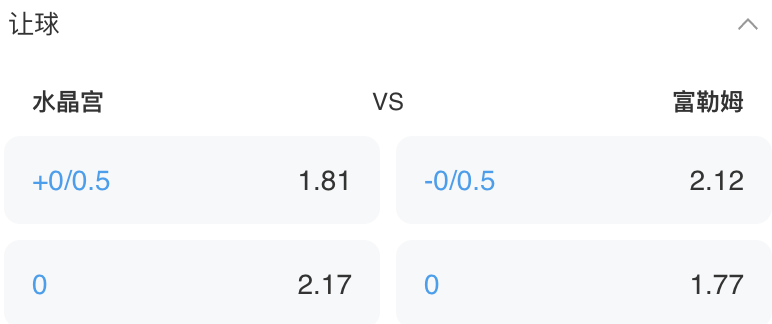
Definition: Predict the team to win after applying the handicap line. (For football live/in-play handicap) The score at the time of bet placement must be deducted. For basketball, the score at the time of bet placement does NOT need to be deducted.
Details: There are whole-number handicaps and half-ball (quarter-line) handicaps. Handicap −0/0.5, −1/1.5 can also be called "level/half-ball handicap." Conversely, +0/0.5, +1/1.5 can be called "receive level/half-ball handicap." A quarter-line handicap can produce half-win or half-loss results. When the handicap is a whole number and the result is a draw after applying the handicap, the bet is refunded.
💡 Beginner's Tip: A handicap gives the weaker team an "extra" score or makes the stronger team "give up" goals before comparing. For example, if Team A gives a 1-goal handicap, Team A must win by at least 2 goals for your bet to win. A "quarter line" (e.g., −0/0.5) effectively splits your stake 50/50 across two adjacent handicap lines.
Additional Notes: Example — if a member bets 100 on Handicap −0/0.5, it can be understood as 50 on the −0 line and 50 on the −0.5 line. If the full-time score is 0-0: the member loses half, because the −0 portion is a draw (refunded), while the −0.5 portion means the score becomes 0 vs 0.5 = loss, losing 50. If the full-time score is 1-0: the member wins. If the full-time score is 0-1: the member loses. Half-loss is calculated at 0.5 (European odds). For a stake of 100: 100 × 0.5. Half-loss means losing half the stake. In accumulator/parlay calculations, a half-loss is treated as odds of 0.5.
1.3 Over/Under (大/小)
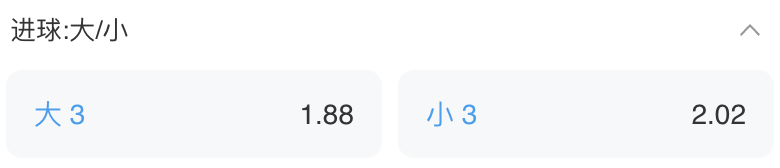
Definition: Predict whether the total goals will be over or under a specified number.
Details: Betting Over 2 — if total goals are less than 2, the bet loses; equal to 2 is a draw (refund); more than 2 wins.
Additional Notes: Over/Under can also follow the quarter-line rules described in the Handicap section.
💡 Beginner's Tip: For example, if the line is 2.5 goals, 3 or more total goals = Over wins, 2 or fewer = Under wins. Lines ending in .5 never produce a draw/refund.
1.4 Odd/Even (单/双)
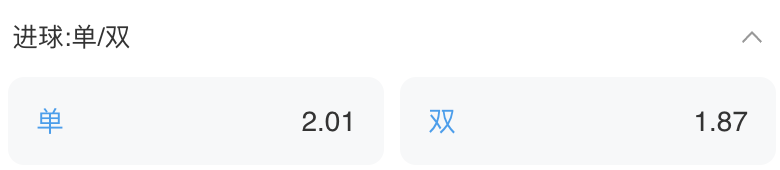
Definition: Predict whether the total number of goals is odd or even.
Details: Odd numbers count as Odd; even numbers count as Even. 0 counts as Even.
Additional Notes: 1/3/5/7/9 = Odd; 0/2/4/6/8 = Even.
1.5 Correct Score (波胆)
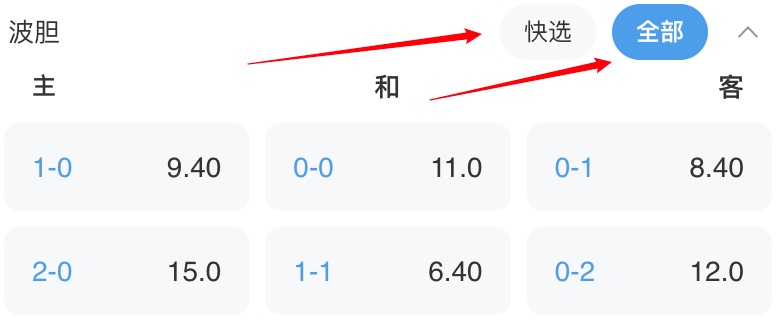
Definition: Predict the exact final score of the match.
Details: Predict the exact final score. Correct prediction = win; incorrect = loss. "Any Other Score" covers all scores not listed as options. No draw/refund exists in this market.
Additional Notes: If a member bets on Correct Score 3-2, the match must end exactly 3-2 to win; any other result is a loss. "Any Other Score" refers to scores beyond the listed options, typically those containing 5-5 or higher digits.
💡 Beginner's Tip: Correct Score means predicting the exact score — the hardest market but with the highest odds. Choosing "Any Other Score" is a bet that a rare scoreline will occur.
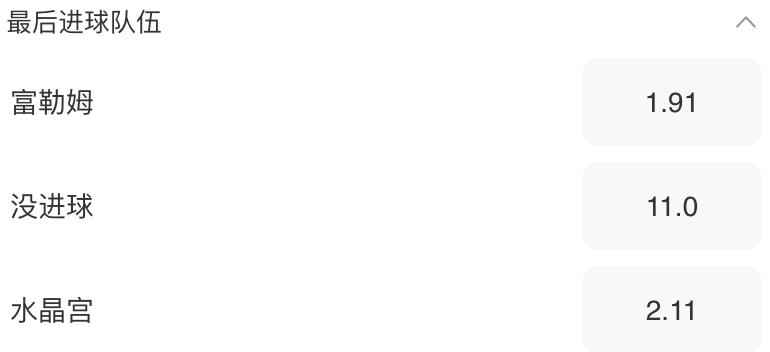
1.6 First/Last Goal
Definition: Predict which team will score the first/last goal.
Details: Options include First Goal / Last Goal / No Goal.
Additional Notes: Correct prediction wins; incorrect loses.
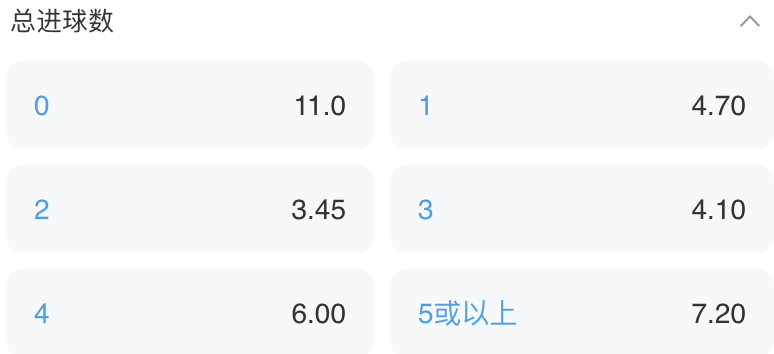
1.7 Total Goals
Definition: Predict the total goals range.
Details: Example — betting on 2-3 means you win if total goals fall within the 2-3 range, such as 1-1, 2-1, 1-2, 0-2, 0-3, etc.
Additional Notes: If the total falls outside the range, the bet loses.
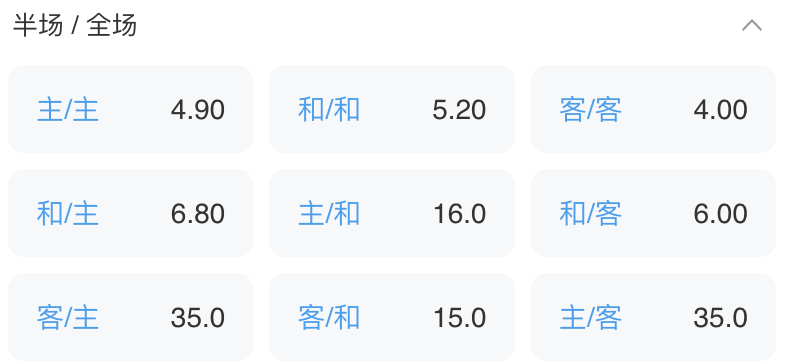
1.8 Half Time/Full Time (半/全场)
Definition: Predict the winning team at half time AND at full time.
Details: Example — betting Home/Draw means predicting Home leads at half time and the match ends in a draw at full time. Both conditions must be met to win; if one or neither is met, the bet loses.
Additional Notes: There are 9 possible outcomes; select one as your prediction.
💡 Beginner's Tip: 9 outcomes = 3 half-time results (Home/Away/Draw) × 3 full-time results (Home/Away/Draw). Both conditions must be correct to win.
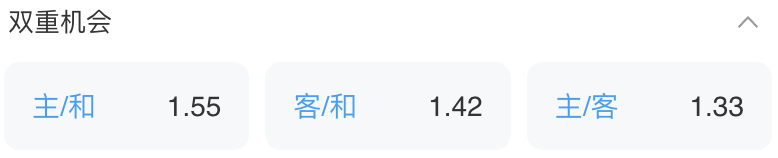
1.9 Double Chance (双重机会)
Definition: Select two of the three possible match outcomes: Home or Draw (1 and X), Away or Draw (2 and X), or Home or Away (1 and 2).
Details: Example — betting Home/Away means if either Home or Away wins, the bet wins.
Additional Notes: A match has 3 possible outcomes: Home win, Away win, or Draw. This market allows you to cover two of the three outcomes.
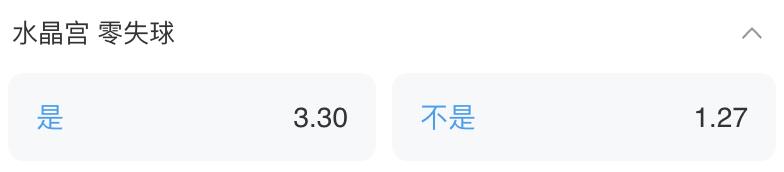
1.10 Clean Sheet (零失球)
Definition: Predict whether a specific team will keep a clean sheet (concede zero goals) in the 90-minute match.
Details: Example — predict whether the Home team will keep a clean sheet: "Yes" or "No."
Additional Notes: A 0-0 result also counts as a win for "Yes."
1.11 Clean Sheet Win
Definition: Predict whether a specific team will win the match without conceding any goals in the 90-minute match.
Details: Example — predict Home Clean Sheet Win "Yes" or "No." If the prediction is correct, the bet wins; otherwise, it loses.
Additional Notes: A 0-0 draw (no win) means the bet loses.

1.12 Both Teams to Score
Definition: Predict whether both teams will score.
Details: First Half / Full Time — "Yes" or "No."

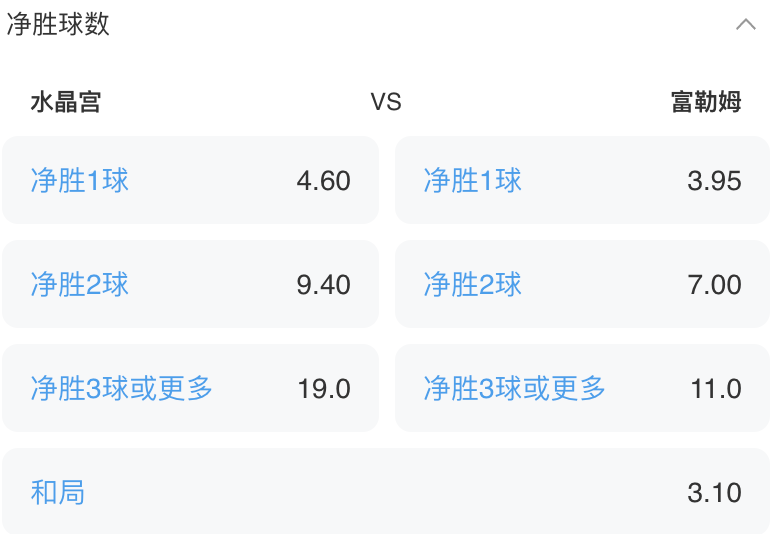
1.13 Winning Margin
Definition: Predict the exact winning margin at the end of the match.
Details: Example — betting Home to win by 1 goal means if the Home team finishes with exactly 1 more goal than the Away team, you win.
Additional Notes: A draw means both teams scored the same number of goals.
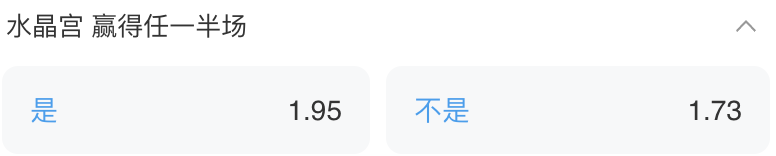
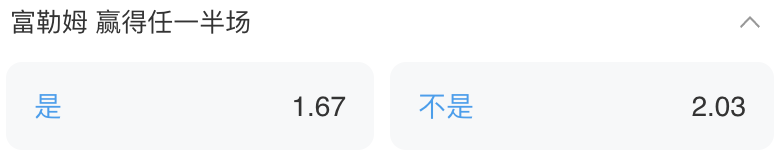
1.14 Win Either Half
Definition: Predict whether the selected team will outscore the opponent in at least one half within 90 minutes (excluding extra time and penalties).
Details: This market covers both the first half and second half. The bet wins if the predicted team wins either half.
Additional Notes: If both halves end 0-0, the bet loses.
1.15 Win Both Halves
Definition: Predict whether the selected team will outscore the opponent in BOTH halves within 90 minutes (excluding extra time and penalties).
Details: The team must score in both halves and outscore the opponent in each.
Additional Notes: If either half ends level or with no goals, all bets are settled as losses. Example — Home leads 1-0 at half time, and the full-time score is also 1-0. This means no goals were scored in the second half, so only one half was won, making the bet a loss.
1.16 Handicap Home/Draw/Away
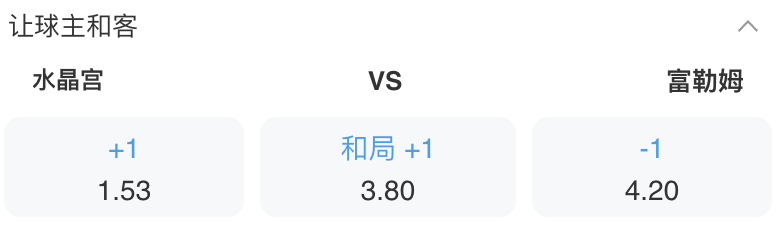
Definition: Predict the 90-minute full-time winner based on the handicap line, including the possibility of a draw as a third outcome.
Details: Example: Bet Home or Away +1 — if the final result, with +1 applied to the selected team, is a win, the bet wins. Bet "Draw & Home −1 or +1, etc." — "Draw & Home" here refers to the Home team; see rules on the right.
Additional Notes:
-
Draw & Home −1: If the selected team wins the match by exactly 1 goal, you win. E.g., 1-0, 2-1, 3-2 — Home has exactly 1 more goal than Away.
-
Draw & Home +1: If the selected team loses the match by exactly 1 goal, you win. E.g., 0-1, 1-2, 2-3 — Home has exactly 1 fewer goal than Away.
-
Draw & Home −N: If the selected team wins by exactly N goals (N can be 1/2/3/4/5), you win.
-
Draw & Home +N: If the selected team loses by exactly N goals (N can be 1/2/3/4/5), you win.
Important: In the Handicap Home/Draw/Away market, there is NO need to deduct the live score at bet placement. If you bet Home or Away and the adjusted result is a draw, you lose — there is no draw refund.
💡 Beginner's Tip: The key difference from regular Handicap — in regular Handicap, a draw after adjustment means a refund; here, a draw means you lose. "Draw & Home −1" is a bet that Home wins by exactly 1 goal (no more, no less).
1.17 Handicap + 1X2
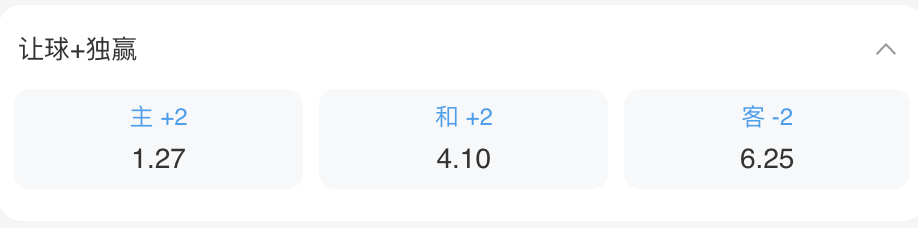
Definition: Predict the final result after applying the handicap.
Details: The "Draw" in this market is calculated based on the Home team by default. No need to deduct the live score at bet placement.
Additional Notes:
Home +1 (or Home −1) When betting Home + or Home −, the Home team receives the stated adjustment; if the adjusted result shows a Home win, the bet wins. Example: Home +1, with a final score of 1-1, 1-0, or 3-1 — adding +1 to Home gives 2-1, 2-0, or 4-1 respectively. Home wins with the adjustment, so the bet wins. If the score is 0-1 or 0-2 and Home gets +1, that becomes 1-1 or 1-2. Home does not win after adjustment, so the bet loses.
Away +1 (or Away −1) Same rules as Home +1/−1 above, but applied to the Away team's score.
Draw +1 (or Draw −1) The "Draw" option is calculated based on the Home team by default. When betting Draw + or Draw −, the adjustment is applied to the Home team's score. If the adjusted score results in a draw, the bet wins. Example: Draw +1 with a full-time score of 0-1 or 1-2 (trailing by 1). Adding +1 to Home creates a draw = win. Example: Draw −1 with a full-time score of 1-0 or 2-1 (leading by 1). Subtracting 1 from Home creates a draw = win.
The same logic applies for +2/−2, +3/−3, and so on.
If the adjusted result matches the predicted outcome (Home win, Away win, or Draw), the bet wins. Otherwise, it loses.
1.18 Combo Markets (1X2 & Over/Under, etc.)
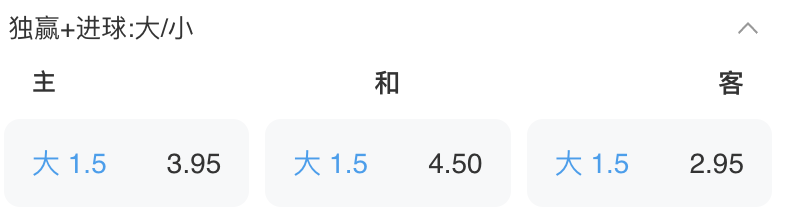
Definition: The "&" symbol means both conditions must be met. It can also be read as "+", combining two markets into one.
This covers four types: - 1X2 & Over/Under - 1X2 & Both Teams to Score - Double Chance & Over/Under - Double Chance & Both Teams to Score
Details: Example — betting on: 1X2 & Over/Under, selection: Home & Over 2.5.
Additional Notes: The final result must have Home winning AND total goals over 2.5 to win. If either condition is not met, the bet loses. All four variations follow the same logic — both conditions must be satisfied.
💡 Beginner's Tip: Combo markets require both conditions to be met simultaneously. The odds are higher than betting each separately, but the difficulty is also greater — fail on either condition and the whole bet loses.
1.19 Highest Scoring Half
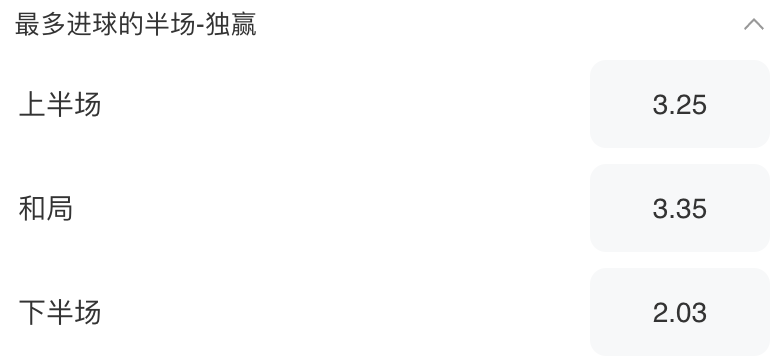
Definition: Predict which half will have the most goals.
Details: Options: First Half / Second Half / Equal.
1.20 Score in Both Halves
Definition: Predict whether a team will score in both halves.
Details: "Yes" or "No."
Additional Notes: Refers to the first half and second half.
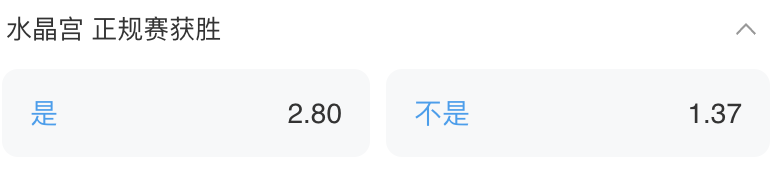
1.21 Win in Regular Time
Definition: Predict whether the specified team will win within 90 minutes of regular time.
Details: If the match is still level after 90 minutes, betting "No" wins.
Additional Notes: Similar to the 1X2 market.
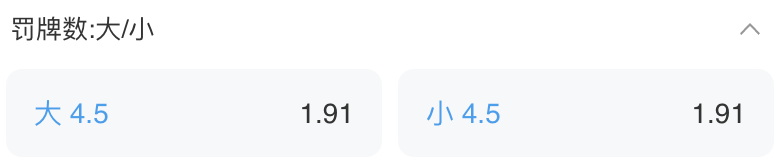
1.22 Booking Points (罚牌数)
Definition: Booking points are calculated by points, not by card count.
Details: Cards shown to non-players (e.g., coaches, non-substitute bench players, staff, etc.) are NOT counted.
Additional Notes: A yellow card = 1 point; a red card = 2 points. If a player receives two yellow cards, the total booking points for that player are: 1 (yellow) + 2 (red) = 3 points. (Maximum 3 points per player per match.)
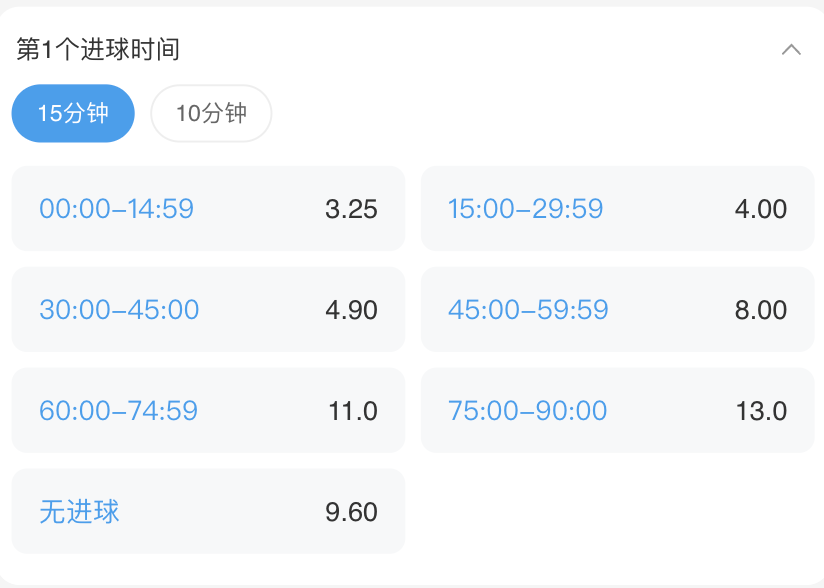
1.23 Time of First Goal
Definition: 15-minute / 10-minute intervals.
Details: Predict in which time interval the first goal will be scored. One option is "No Goal," meaning no goals in the entire 90 minutes (including injury time).
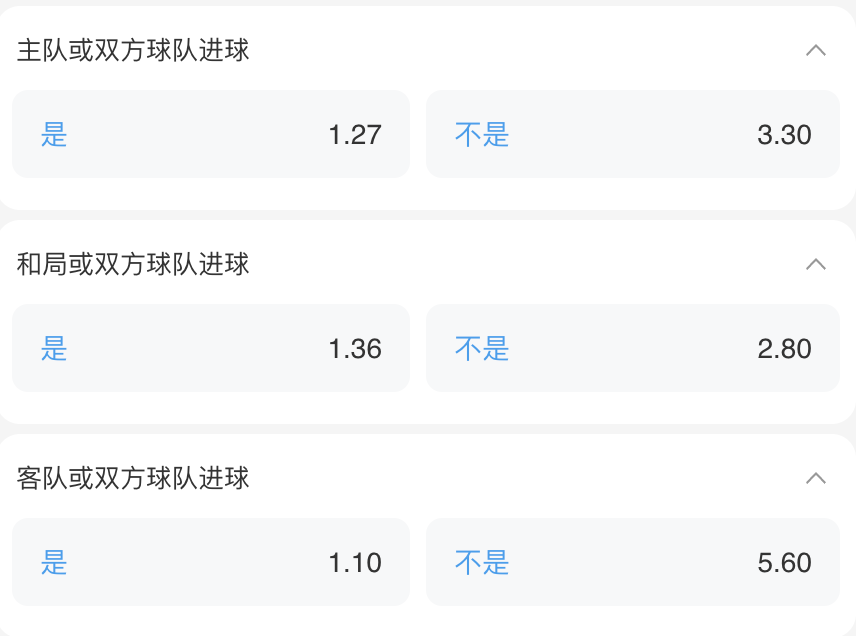
1.24 Home or Both Teams to Score / Away or Both Teams to Score / Draw or Both Teams to Score
Definition: Three-in-one market — see sub-sections below.
Home or Both Teams to Score
- Bet Yes: Requires the Home team to score OR both teams to score. If Home does not score, betting "Yes" loses.
- Bet No: Requires the Home team NOT to score. If Home scores, the bet loses.
Away or Both Teams to Score
- Bet Yes: Requires the Away team to score OR both teams to score. If Away does not score, betting "Yes" loses.
- Bet No: Requires the Away team NOT to score. If Away scores, the bet loses.
In simple terms: betting on a specific team — "Yes" = that team MUST score. "No" = that team must NOT score.
Draw or Both Teams to Score
Case 1 — No goals or only one team scores: just determine whether the result is a Draw.
- 0-0: "Yes" wins.
- 0-1, 1-0, or higher one-sided scores: "No" wins.
Case 2 — Both teams score: just determine whether Both Teams to Score is met.
- 2-1, 1-2, or higher with both scoring: "Yes" wins; "No" loses.
Identical scores (both teams scored)
- 1-1, 2-2, or higher: "Yes" wins; "No" loses.
Market Examples
| Score | Analysis | "Yes" Result |
|---|---|---|
| 1-1, 2-2, 3-3, 4-4 | Both a draw and both teams scored | Win |
| 2-1, 1-2, 3-2, 2-3, 1-3, 4-1, etc. | Not a draw, but both teams scored | Win |
| 1-0, 0-1, 2-0, 0-2 | Only one team scored; not a draw; not both teams scoring | Loss ("No" wins) |
| 0-0 | A draw, but NOT both teams scoring (no goals ≠ both teams scoring) | Win |
1.25 Sending Off
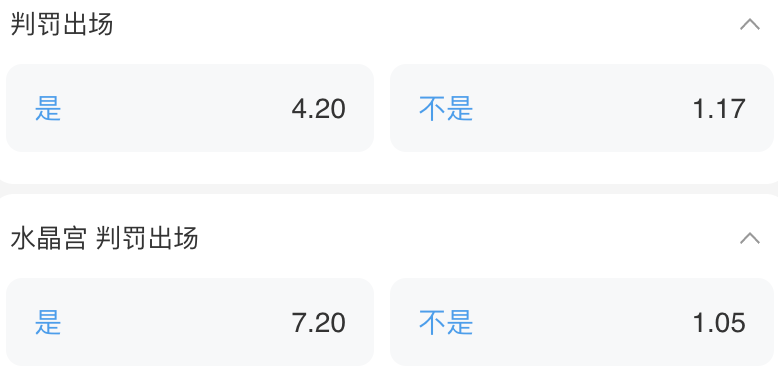
Definition: Whether any on-field player will be sent off during the specified period (full time, first half, or second half). Or predict which team will have a player sent off.
Details: Predict whether a team will have a player sent off.
1.26 Basketball · Highest Scoring Quarter
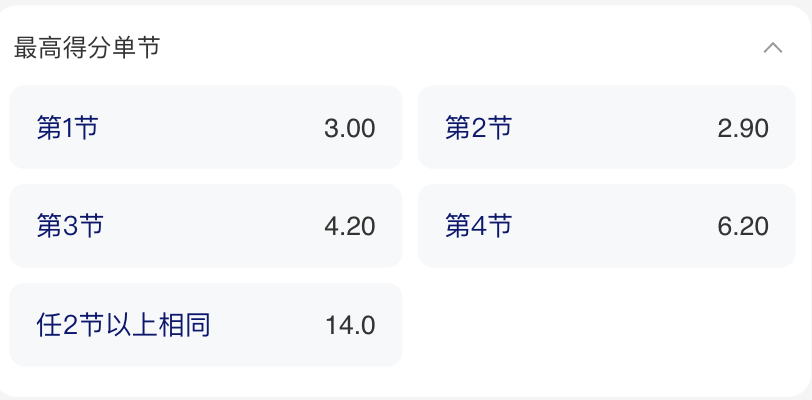
Definition: Predict which quarter will have the highest combined score of both teams. Includes an option for two or more quarters being tied for the highest.
If the match is interrupted before the completion of 4 quarters, all bets are void.
Details: The total score for each quarter is calculated. Example: Q1 score 16-17, total = 33.
Additional Notes: "Two or more quarters tied for highest" — Two or more quarters must have the same total AND that total must be the highest among all quarters. If two quarters have the same total but it is not the highest, the bet on "tied" loses. Example: - Q1: 50 - Q2: 47 - Q3: 50 - Q4: 55
In this case, "Q4" wins; all others lose. If Q4 were below 50, then "Two or more quarters tied" would win.
1.27 Basketball · First Free Throw Team
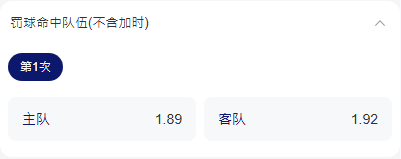
Definition: Predict which team will be the first to make a free throw (first successful free throw).
Additional Notes: As the name implies — whichever team makes a free throw first wins.
1.28 Sending Off (Basketball)
Definition: Whether any on-field player will be sent off during the specified period (full time, first half, or second half). Or predict which team will have a player sent off.
Details: Predict whether a team will have a player sent off.
Rules are the same as Football Sending Off (1.25), applied to basketball matches.
📘 Source: Group Sports Betting Rules.xlsx
2. Match Categories
2.1 Live/In-Play (滚球)
Definition: Matches currently in progress.
Details: Also known as live betting, in-play betting, in-running, etc.
2.2 Upcoming
Definition: Matches about to begin, generally within 24 hours.
Details: Filter options: 1 hour / 3 hours / 6 hours / 12 hours / 24 hours.
2.3 Today
Definition: Matches scheduled for today that have not yet started.
Details: Pre-match bets are also called "opening odds" or "early odds."
2.4 Early Markets
Definition: Matches scheduled for tomorrow and beyond.
2.5 Accumulator/Parlay (串关)
Definition: Combine multiple selections into one bet for higher odds. Available in singles and system bets. Only one selection per match is allowed.
Details: An Accumulator/Parlay requires selecting two or more events in a single bet slip. Every selection must win for the accumulator bet to win. The platform supports up to 10-fold accumulators with 1,013 combinations.
Parlay Calculation Formulas:
Single Accumulator (e.g., 3-fold)
Unit Stake × Odds1 × Odds2 × Odds3 − Stake = Net Profit
System Bet (e.g., 3-selection / 4-bet system)
Consists of 3 doubles and 1 treble, totaling 4 bets:
(Total Stake ÷ Number of Bets) × (Odds1×Odds2 + Odds1×Odds3 + Odds2×Odds3 + Odds1×Odds2×Odds3) − Total Stake = Net Profit
i.e., Unit Stake = Total Stake / Number of Bets
💡 Beginner's Tip: An accumulator/parlay multiplies the odds of multiple matches together — very high potential payout but high risk — get one wrong and the entire bet loses. A "3-fold" means all 3 must win (1 bet). A "3-selection / 4-bet system" splits 3 matches into multiple combinations (4 bets), so you can still win some combinations even if 1 selection loses.
3. Match Progress
3.1 Full Time
Definition: The completed match.
Details: A match consists of two halves, 45 minutes each, with a 15-minute half-time break. Total regular time = 90 minutes.
3.2 Half Time
Definition: Unless otherwise specified, this refers to the first half.
3.3 Extra Time
Definition: After the 90-minute regular time, an additional 30 minutes of extra time is played (two 15-minute halves).
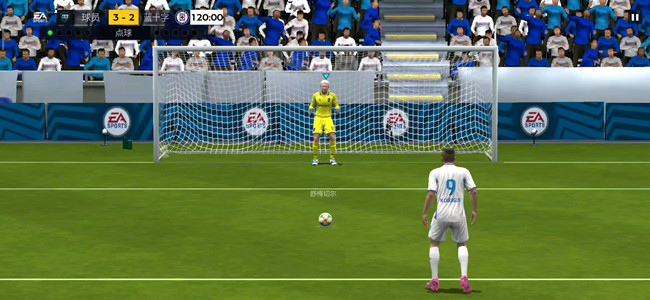
3.4 Football Penalty Shootout
Definition: A penalty shootout takes place when a winner must be decided after extra time ends in a draw.
Details: Each team takes 5 penalties, alternating kicks.
Additional Notes: In some matches, if the result is already decided, the shootout may end early. For example, if after 3 rounds the score is 3-0, even if the trailing team scores in the remaining 2 rounds, the result cannot change, so the shootout ends early.
3.5 Football Sudden Death
Definition: A sudden-death round takes place when the penalty shootout ends in a tie and a winner must be decided.
Details: Each team takes one kick per round, continuing until one team wins a round.
Additional Notes: For example, in round 1, Team A scores and Team B scores — proceed to round 2. As soon as one round produces different results (one scores, one misses), the shootout ends immediately.
4. Sports Knowledge
4.1 Home Ground / Home Team
Definition: A match held in the home team's city.
4.2 Away Ground / Away Team
Definition: A match held in the away team's city.
4.3 Neutral Venue
Definition: A match held in a third-party city, belonging to neither team.
4.4 Odds
Definition: The payout multiplier (also colloquially called "water" or "price").
4.5 Youth Tournaments U16–U21
Definition: Youth / senior tournaments, etc. (Youth friendlies and similar events may have 40- or 35-minute halves.) The number generally represents the age limit, e.g., U17 = under 17 years old.
4.6 Abandoned Match
Definition: A match suspended due to unforeseen circumstances. The decision to resume is made based on official announcements.
4.7 Danger Ball
Definition: A situation with a high probability of a goal — penalties, cards, or other events likely to affect the score.
4.8 Valid Turnover (有效投注)
Definition: A bet placed at odds of 0.60 or above (European odds 1.60 or above), settled with a win or loss result. A half-win counts profit as valid turnover; a half-loss counts the lost amount as valid turnover. Draws, unsettled, or voided bets do NOT count as valid turnover. After meeting the valid turnover odds threshold: if profit > stake, valid turnover = stake; if profit < stake, valid turnover = profit.
System 2.0 Sports Betting Odds Threshold:
On System 2.0, bets below the following odds thresholds will NOT count as valid turnover (all in Hong Kong odds): - Football: below 0.6 (exclusive) - Basketball: below 0.6 (exclusive) - Tennis: below 0.6 (exclusive) - Baseball: below 0.6 (exclusive)
💡 Beginner's Tip: Valid Turnover is the core concept used to calculate wagering requirements. Bets with odds too low (below 0.6) do not count — this prevents users from hedging with low-odds bets to inflate turnover. Draws and voided bets also don't count. When reviewing a user's wagering/turnover, always keep this threshold in mind.
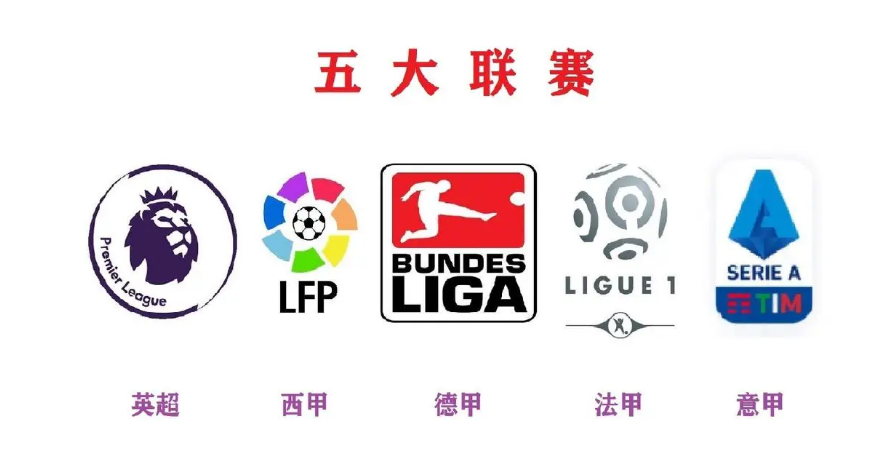
4.9 Top Five Leagues(五大联赛)
Definition: English Premier League, Ligue 1 (France), Bundesliga (Germany), Serie A (Italy), La Liga (Spain).
The top five European football leagues are the most-watched and highest-level domestic football competitions globally:
| League | Full Name | Abbr. | Country | Season | Highlights |
|---|---|---|---|---|---|
| EPL | English Premier League | EPL | England | Aug – May | Highest global broadcast reach, fastest pace |
| La Liga | La Liga (Spain) | La Liga | Spain | Aug – May | Technical style, home to Real Madrid & Barcelona |
| Bundesliga | Bundesliga (Germany) | BL | Germany | Aug – May | Best fan culture, highest stadium attendance globally |
| Serie A | Serie A (Italy) | Serie A | Italy | Aug – May | Tactical discipline, renowned defensive systems |
| Ligue 1 | Ligue 1 (France) | L1 | France | Aug – May | Rising attention due to PSG (Paris Saint-Germain) |
💡 Beginner's Tip: All five leagues run from August to May, with weekends as the primary match days. These are the core source of sports betting markets — the most diverse odds and most transparent data.
4.10 World Cup(世界杯)
Definition: The FIFA World Cup is held every 4 years.
The FIFA World Cup is the highest-level national team football tournament organized by FIFA (Fédération Internationale de Football Association).
| Item | Details |
|---|---|
| Full Name | FIFA World Cup |
| Frequency | Every 4 years |
| Teams | 32 national teams (expanding to 48 from 2026) |
| Format | Group stage (round-robin) → Knockout (Round of 16 → QF → SF → Final) |
| Timing | Usually June–July (summer); 2022 Qatar was Nov–Dec exception |
| Next Edition | 2026, hosted by USA / Canada / Mexico |
💡 Beginner's Tip: The World Cup is the most-watched sporting event on Earth. It lasts about 1 month, during which sports betting volume surges significantly. Key difference: group stage matches can end in a draw; knockout matches must produce a winner (extra time → penalties).

4.11 Match Anomalies
Definition: In case of special circumstances such as postponement, suspension, or termination.
Details: If the match resumes within 5 hours or there is an official announcement, bets remain valid. If the match does not resume, bets are refunded after 5 hours. In accumulators/parlays, the voided selection is treated as odds of 1.
4.12 Number of Players
Definition: A football match has two teams, each with 11 players including the goalkeeper. If either team has fewer than 7 players, the match cannot begin.
4.13 Basketball
Definition: NBA and CBA are divided into 4 quarters, 12 minutes each.
Details: Some international games have 10-minute quarters. Every 2 quarters constitute one half.
Additional Notes:
NCAA (Men's College Basketball): Typically played in two 20-minute halves with a 15-minute halftime break and 5-minute overtime periods. The two-half format is a long-standing tradition rooted in the league's established global brand and unique commercial value.
WNCAA (Women's College Basketball): Typically played in 4 quarters of 10 minutes each. Q1 + Q2 = first half; Q3 + Q4 = second half. Short breaks between quarters (usually ~2 minutes), with a 15-minute halftime break. The 4-quarter format (different from men's) was adopted to better align with international FIBA, Olympic, and World Cup standards.
Overtime Rules:
| System | Rule |
|---|---|
| System 2.0 | Basketball second-half / full-time bets include overtime; Q4 bets do NOT include overtime |
| Ali/Tencent | Only full-time bets include overtime; Q1, Q2, Q3, Q4, first half, and second half do NOT include overtime |
4.14 Football Corners
Definition: Corner kicks are typically signaled by the assistant referee (linesman). When the assistant referee determines it's a corner, they raise their flag, point toward the corner area on the relevant side, then raise both arms pointing at the corner flag area where the kick will be taken, and the player takes the corner kick from there.
Additional Notes: A corner kick is awarded when the ball crosses the goal line (including when the goalkeeper deflects a shot over the line) after last being touched by a defending player. Corner kicks are taken from one of the four corner arcs.

5. Tennis Knowledge
5.1 Game
Definition: Within a game, possible point scores are 0, 15, 30, 40, and game. These are equivalent to 0, 1, 2, 3, and game. When one side wins a point, the score reads 15-0, and so on. A score of 40-40 is called Deuce. At deuce, the player who scores the next point has "Advantage." A player must lead by at least 2 points to win the game; when a game is won, the game count increases by 1.
5.2 Set
Definition: A set is composed of games. The first side to reach 6 games wins the set, e.g., 6-0, 6-1, 6-2, 6-3, 6-4. Similarly, a player must lead by at least 2 games to win the set, so when the game score reaches 5-5, one side must win 2 consecutive games. If the score reaches 6-6, a tiebreak is played to decide the set.
5.3 Market Knowledge
Definition: Generally, the player who first wins 6 games with at least a 2-game lead wins the set. If a player reaches 6 games without a 2-game lead, the set continues until one player leads by 2 games (i.e., scores like 6-4, 7-5, 8-6 end the set, but scores like 6-5, 7-6, 8-7 mean the set continues because the leading player does not have a 2-game margin). This scoring system is called the "advantage set." In professional tournaments, this format typically only appears in the final set (the 5th set in best-of-5 matches or the 3rd set in best-of-3 matches), though some events use this format exclusively.
5.4 Scoring Method
Definition: Another common scoring method is that when a set reaches 6-6, a special "tiebreak game" is played. The player who wins the tiebreak wins the set 7-6. In some cases, in best-of-5 matches, if the final set reaches 6-6, no tiebreak is played — instead, the traditional format continues until one player wins 2 consecutive games.
5.5 Tiebreak (7-Point)
Definition: The first player to reach 7 points wins the game and the set (if tied at 6-6, one player must lead by 2 points, e.g., 9-7). The server serves the first point; the opponent serves the 2nd and 3rd points; thereafter, each player serves 2 consecutive points in alternation. The 1st point is served from the deuce court (right side), the 2nd from the ad court (left side), the 3rd from the deuce court, and so on.
5.6 Match Tiebreak (10-Point)
Definition: In events where the deciding set uses a 10-point tiebreak format, only 1 game is played. The first player to reach 10 points with a lead of 2 or more points wins. If the score reaches 8-8, the player must lead by 2 to win. This deciding set result counts as only 1 game.
5.7 Scoring
Definition: A point is awarded to the opponent in any of these situations: - Two consecutive serve faults (double fault) - Opponent's return hits the net - Opponent's return goes out of bounds - Opponent fails to hit the ball before it bounces twice - Opponent's racket touches the ball twice on a return
Any of these occurrences results in 1 point for the other player.
6. Baseball Knowledge
6.1 Baseball Fundamentals
Basics
- The batter and all the fielders (including the catcher squatting behind the batter and the pitcher) are on different teams. The fielders' goal is to cooperate to get the batter out.
- The batter's goal is to hit the ball where the fielders can't reach it — the farther, the better. The pitcher tries everything to make the batter miss or hit weakly.
- During the time between the ball being hit and being retrieved by the fielders, the batter can advance counterclockwise through four bases (base running) and return to home plate to score 1 run. If the ball is returned while the runner is between bases, the runner may be tagged out. However, a runner is safe at any time while touching a base.
- Only one runner is allowed on each base; only one runner is safe.
- If the batter doesn't complete the full circuit but isn't tagged out and stops at a base, they may continue from that base on the next play.
- If the batter misses 3 pitches, they are out (strikeout). If the pitcher throws 4 balls (pitches too wide to hit), the batter advances to first base; if there are already runners on base, they advance one base as well. Even if a pitch is a ball, swinging at it means it doesn't count as a ball.
- After a successful hit, the batter must run; then the next batter comes up.
- If the ball is hit so far the fielders can't retrieve it (usually into the stands), it's a home run.
- The boundaries are the two lines extending at a right angle behind the batter. The fair territory is the angular area between these lines — even if it extends all the way to Mars, it's still fair territory.
- When 3 batters are out, the half-inning ends and the teams switch roles.
Advanced
- The batting team is on offense. Only the offensive team can score during a half-inning. The defensive team (fielders) tries to prevent runs and get batters/runners out.
- The person squatting behind the batter is the catcher, who receives pitches from the pitcher. The catcher, pitcher, and batter have fixed positions.
- Behind the catcher is the umpire. The umpire determines whether a pitch is a ball — if it is, the umpire calls "Ball~!"
- With only 4 bases, a maximum of 4 offensive players can be on the field at any time, one of whom is at home plate batting. The player at home plate is called the batter; the others are base runners.
- After a hit, the batter must run to first base. If first base is occupied (by a teammate), the runner at first must advance to second; if second is occupied, that runner must advance to third. This mandatory advance caused by the batter reaching base is called a "force play." Forced runners can be forced out.
- If there are runners on all bases and a home run is hit, the offensive team scores 4 runs at once (a grand slam) — all 4 players jog around the bases and leave the field.
Ways the Offense Gets Out
- Missing 3 pitches (strikeout).
- A hit ball is caught before touching the ground by any fielder — the batter is immediately out (flyout/catch).
- A runner is touched by a fielder holding the ball while not on a base (tag out).
- A forced runner is out if a fielder holding the ball touches the destination base before the runner arrives (force out). Fielders can throw the ball to each other to record multiple outs on a single play.
6.2 Common 9th Inning Questions
Definition: In the 9th inning, if the batting team's score is lower than the fielding team's and the batting team has used up all at-bats, the result is decided immediately. The team in the lead does not need to bat in the bottom half.
6.3 International Rules (Mercy Rule / Early Termination)
Definition: Under international baseball rules, if one team leads by 10 or more runs after at least 7 innings, or by 15 or more runs after at least 5 innings, the game ends early. In this situation, all bets remain valid, including Moneyline, Odd/Even, Run Line (handicap), and Totals (over/under).
6.4 International Rules (Run Line / Totals)
Definition: For Run Line and Totals bets, the result is based on the score after 9 innings (or 8½ innings if the home team is already ahead). If the game is suspended or interrupted during extra innings, the score reverts to the end of the last completed inning — unless the home team tied the score or took the lead during the extra-inning bottom half, in which case the score at the time of suspension stands.
📘 Source: Group Sports Betting Rules.xlsx